
Welcome
PH Property Holdings Ltd is excited to share plans for a bespoke development of new townhouses at Great John Street.
Below, you’ll find information about the site, our proposals, the consultation process and our next steps.

Introducing
PH Property Holdings Ltd.
PH Property Holdings Ltd is one of the UK’s most successful premium house builders.
Over the past 30 years, we have built a strong reputation for creating high-quality homes in exceptional locations – from family houses, schools and country estates in the UK to landmark villas overseas.
With our recent acquisition of Equitable Buildings on St Ann Street, and now with Great John Street, we are bringing this level of craftsmanship and design quality to Manchester city centre, combining thoughtful architecture with lasting quality and attention to detail.
Artist’s impression the proposals, as seen from above Great John Street
A selection of schemes delivered by PH Property Holdings Ltd.
The Site:
Location
and context
The proposed development site was previously home to Breeze Studios, a privately owned plot of land located in the heart of Manchester City Centre. It is bordered by Great John Street to the north, Atherton Street to the west, Grape Street to the south, and Lower Byrom Street to the east.
The site occupies a prominent position but is currently unused and have never been accessible to the public.
The surrounding area includes the former Granada Studios site, modern studio buildings, the Grade II listed Great John Street Hotel, and St John’s Gardens.
Aerial view of the site today
North along Lower Byrom Street
West along Great John Street
South West from Atherton Street
The site:
history and opportunity
History
Historically, the site was occupied by terraced houses from the late 18th until the mid-20th century, before being demolished as a result of depopulation in the area after the Second World War. It later became part of Granada Studios and was used as a car park, before being converted in the early 1990s into an enclosed garden to provide Granada Studios with an external study called “Breeze Studios”, which remained in use until the studio’s closure in 2013.
Historical image of the site
Historical images of the site
Historical map from 1832 map showing approximately 23 terraced dwellings on the site
(Source: University of Manchester Archives)
A 1946 aerial view looking north across the site (Source: Britain From Above)
the opportunity
This is a unique opportunity to bring the site back into residential use, creating a place that draws on the area’s character and history while responding to Manchester’s future needs. The vision is to deliver a high-quality development of townhouses that helps meet the growing demand for family housing in the city centre and contributes to a more diverse housing offer. By delivering premium, low-rise family homes, the scheme aims to create a welcoming, long-term community in a location with an established residential character.
The Proposals
Our plans seek to bring new life to the former Breeze Studios site through the delivery of a high-quality, residential-led development.
The proposal includes 21 three-bedroom family homes, each with a private roof terrace, arranged around a landscaped, tree-lined courtyard. A basement car park will provide 21 car parking spaces for residents.
High-quality architecture and sensitive landscaping will ensure the development fits well with the surrounding neighbourhood while enhancing the public realm and creating an attractive, welcoming environment.
The overall ambition is to create a sustainable residential community that contributes positively to the area’s character.
The proposal will help diversify Manchester’s city-centre housing offer through the introduction of premium family townhouses in a location that has historically served a residential purpose. By reinstating the site’s former use, the development will help meet the city’s housing targets, strengthen the area’s sense of place, and support a more balanced housing mix in the city centre.
Artist’s impression the proposals for the site as seen from various viewpoints




21 SUSTAINABLY DESIGNED NEW TOWNHOUSES
TREE-LINED INTERNAL COURTYARD
PRIVATE ROOF TERRACES
BASEMENT PARKING
Design:
site layout
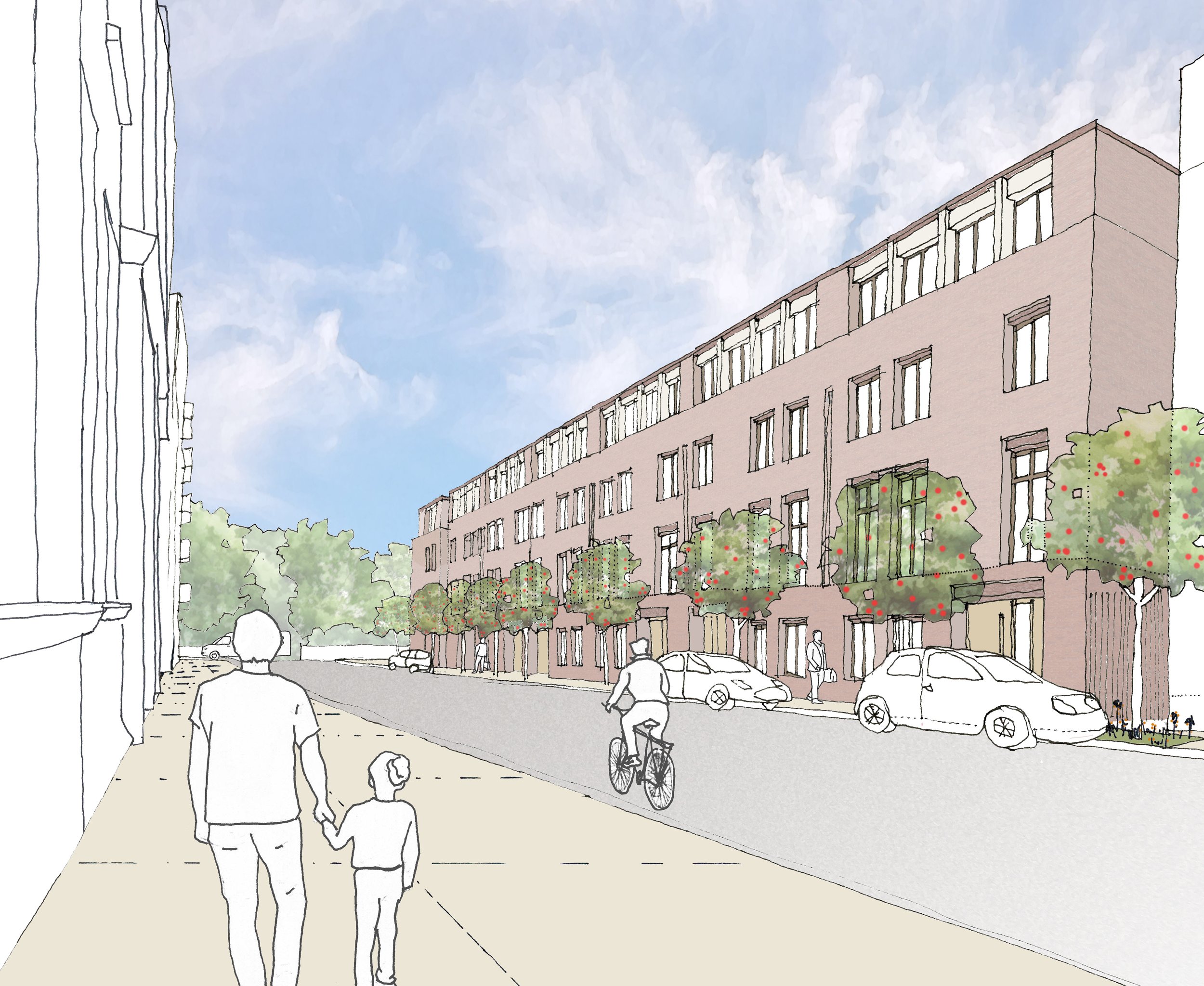
1. Great John Street: A terrace of six homes will face the street, creating a clear and active frontage.
2. Lower Byrom Street: A terrace of five homes will front the street.
3. Grape Street: Homes will be set back about 2m from the boundary, with private rear yards facing the pedestrian route and main entrances from the central courtyard.
4. Atherton Street: A terrace of four homes, with a vehicle access route leading to the ramped basement car park.
A Thoughtfully Designed Neighbourhood
The proposed site layout seeks to re-establish the site’s historic street layout by building 21 new townhouses around the site boundary.
All the townhouses would be arranged around a central landscaped courtyard, which would act as the heart of the development. This shared space would provide residents with a place to relax, meet neighbours, and enjoy outdoor activities.
All homes will also have a secondary entrance from the courtyard, providing easy access to the basement car park and helping to create an active and welcoming courtyard frontage.
Interior precedents
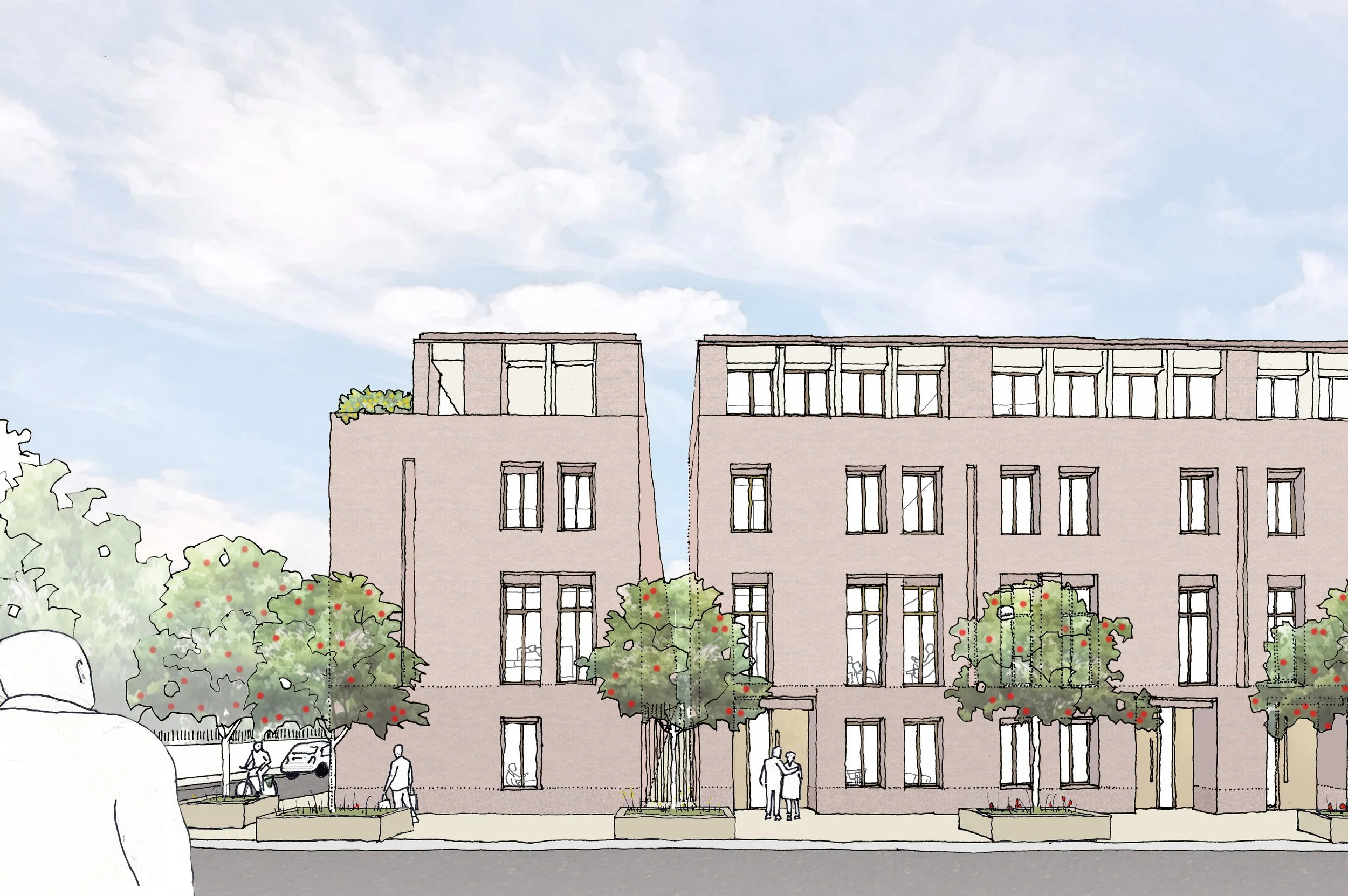
Artist’s impression of the proposals, as seen from the corner of Lower Byrom Street
DESIGN:
Façade & Materials
The architectural design has been carefully developed to respect and complement nearby heritage assets, including the Grade II listed Great John Street Hotel.
The buildings’ appearance draws on the historic character of the area while incorporating contemporary detailing.
Key design principles include:
Creating a clear distinction between the base, middle, and top of the buildings.
Designing the buildings as a cohesive composition, with common features across all elevations.
Positioning living spaces to take advantage of views over both new and existing open spaces.
Using high-quality, contextual materials that respond to the local area and city centre character.
BUILDING MATERIALS
Stone, bronze, and glass have been carefully selected for their durability, quality, and visual harmony with the surrounding architecture, ensuring the development enhances the area’s character.
Stone margins
Brickwork and texture
LANDSCAPE DESIGN
RESIDENTS’ COURTYARD
At the heart of the scheme is a landscaped courtyard, providing shared outdoor space for residents. This green space has been designed as a focal point for the development, offering opportunities for play, social interaction and relaxation.
In addition to providing amenity space, the courtyard will help to enhance biodiversity and improve the site’s environmental performance.
Landscape precedents
TREE REPLACEMENT AND BIODIVERSITY STRATEGY
We are conscious of the value of the existing trees within the site, which were planted as part of the creation of the garden studios in the early 1990s. Our early work has involved an assessment of the health and quality of these trees.
Although our plans would include the removal of all the existing trees within the site, we are taking our tree replacement responsibilities seriously. We are still developing this strategy, but it will include some on-site tree replacement – involving planting new trees along the street frontages and within the courtyard – as well as off-site tree replacement. We will work with Manchester City Council to establish the best location(s) for the off-site tree planting, with the intention of planting taking place within the city centre, if appropriate to do so.
More broadly, our approach to the courtyard design will prioritise soft landscaping and planting which enhances biodiversity, for example plants to encourage bees and insects. Overall, our proposal will deliver at least 10% biodiversity net gain (BNG).
TRANSPORT & CONSTRUCTION
A SUSTAINABLE LOCATION
The site is in a highly accessible and sustainable location, with the full range of city centre amenities just a short walk or cycle away. Residents will also benefit from excellent connections to Manchester’s wider transport network, including the Bee Network, buses, trams, and railway stations. As such, we expect that many of the future residents’ journeys will be made via sustainable travel options.
An Active Travel Plan, which sets out measures that encourage residents to choose sustainable transport options, is being prepared and will be submitted as part of the planning application.

Aerial map of Manchester City Centre. (Courtesy of Google Maps).
PARKING PROVISION
Our plans include one fully accessible parking space for each of the new homes, alongside secure cycle storage. While this level of provision is higher than is typical for city centre residential schemes, this development is a departure from the relatively dense, high-rise projects usually brought forward in central Manchester. As a small development of low-rise homes targeted at a family market, the target purchasers are very likely to expect a parking space, even if they are more likely to undertake many journeys via non-car modes of transport.
All parking will be provided in a secure underground car park. This approach ensures parking is contained within the site and helps to minimise the impact on surrounding streets.
Given the limited number of homes proposed, the development is not expected to create a notable increase in traffic in the surrounding area.
An Active Travel Plan, which sets out measures that encourage residents to choose sustainable transport options, is being prepared and will be submitted as part of the planning application.

CONSTRUCTION STRATEGY
During construction, we will put measures in place to minimise any impact on the surrounding environment and our neighbours. While some disruption is unavoidable, we will ensure it is kept to an absolute minimum. We are also committed to working closely with local residents and businesses throughout the process to address any concerns that may arise.
A Construction Management Plan will be prepared to identify and mitigate potential construction impacts, including working hours, noise and vibration, air quality and dust, construction traffic and highways considerations, and access arrangements around the site.
Once work commences on site, we would anticipate an 18 month construction period.

get involved
The consultation on our plans for Great John Street is now closed.
All feedback received during the consultation period is being carefully reviewed by the project team ahead of finalising the plans and submitting a planning application.
HAVE A QUESTION?
If you have any questions about our proposals or the engagement process, please feel free to get in touch with us via email: info@greatjohnst-consultation.co.uk
meet the team
We are holding a public drop-in session on Tuesday 27 January 2026 at Castlefield Hotel (Liverpool Road, Manchester, M3 4JR) from 4pm to 7pm. This will be an opportunity to find out more about our plans, talk to members of our team, and tell us your views.
If you’re unable to attend the event, please don’t worry as all the information that will be displayed is available to view by clicking the link below.
NEXT STEPS
Following the conclusion of the consultation, all of the feedback received will be considered by the project team before the plans are finalised and a planning application is submitted.
Subject to securing planning approval, construction would likely get underway soon after and take approximately 18 months to complete.